Reward Machine: Shaping a Daily Engagement Loop
UX Researcher III · Primary Researcher
Concept Validation · Prototype Testing · Engagement Strategy
Overview
FanDuel wanted to give Casino players a reason to open the app every day — even when they were not already planning to gamble.
The idea was Reward Machine, a free-to-play experience where players could return daily for a chance to win small cash rewards.
I owned research across both the early concept and the eventual prototype, helping the team determine what the experience needed to be, whether players understood it, and whether the idea was worth investing in before significant engineering work began.
The Problem
Creating a daily engagement mechanic sounds simple. Making one that players actually return to is harder.
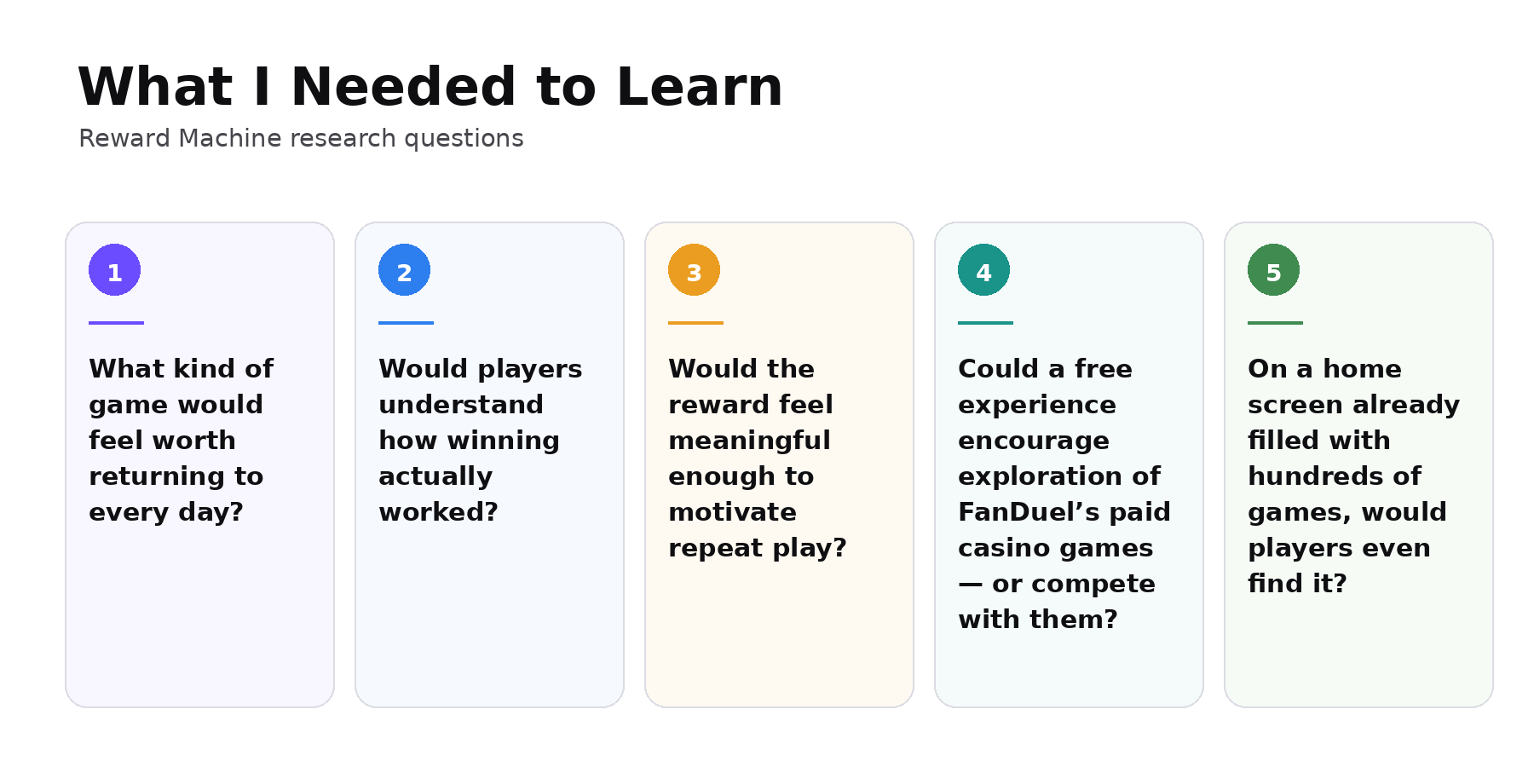
The team knew it wanted a free, low-friction experience, but several important questions were still unresolved.
The research needed to validate not just whether the concept was usable, but whether it had a reason to exist in the player’s routine.
From Broad Idea to Testable Concept
The project was originally scoped to a third-party design firm, but the team decided to bring the work in-house so player needs and UX considerations could shape the concept from the beginning.
I facilitated a design sprint with a 10-person cross-functional group across Product and Design to narrow the opportunity and define a concept we could take into research.
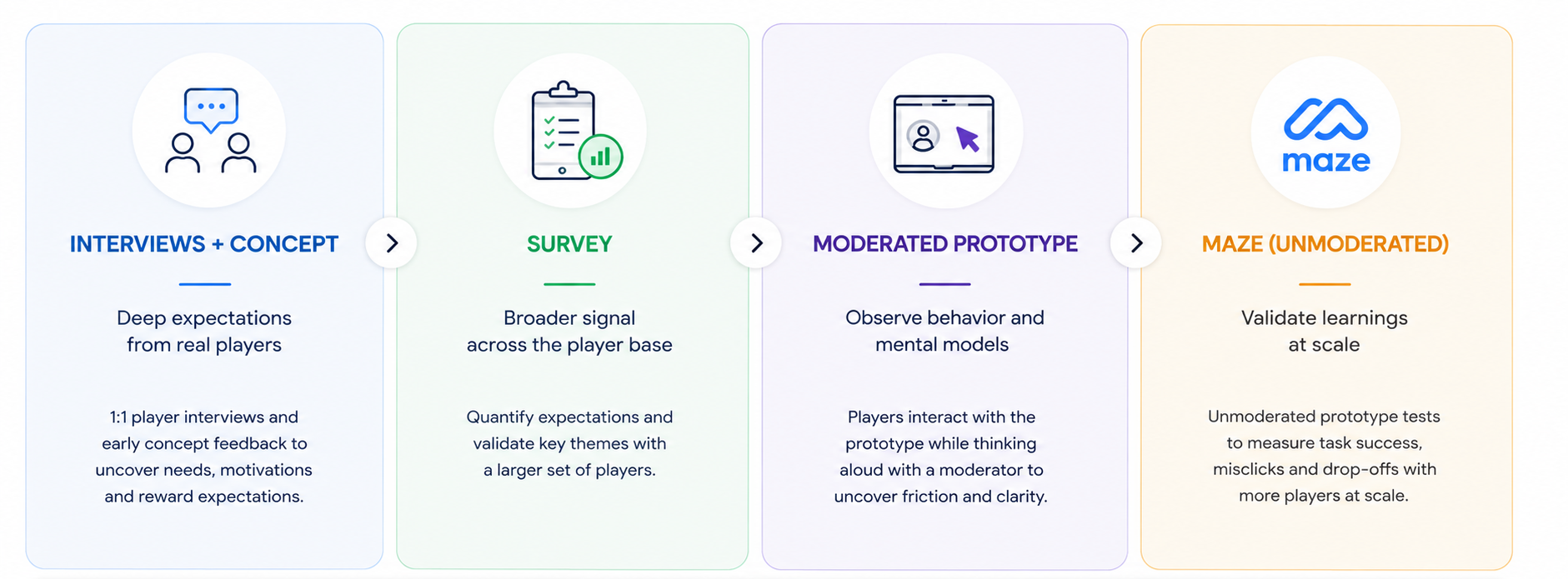
From there, the work moved through three stages, with findings feeding back into the concept at each step.
Research at a Glance
Research methods
Player interviews · Survey · Concept testing · Moderated prototype testing · Maze
Audiences
FanDuel Casino players across web and mobile · Sportsbook cross-sell players
Collaboration
10-person Product + Design sprint
Then, once we recover the real numbers, we add:
Participants
12 interviews · 1600 survey responses · 60 Maze participants
Understand the Expectation
I started with player interviews and concept research before a finished prototype existed.
The goal was to understand the mental model players were bringing into a free daily game: what they expected “winning” to mean, what level of reward felt meaningful, what would make the experience worth returning to, and what might cause them to lose interest.
This phase helped shape the experience before the team committed to detailed interaction design.
Observe Where the Experience Broke
Once the concept became an interactive Figma prototype, I ran moderated 1:1 usability sessions to understand not just whether players could complete the experience, but how they interpreted it along the way.
I watched for moments of hesitation, confusion, and mismatched expectations, then used follow-up questions to understand the reasoning behind those behaviors.
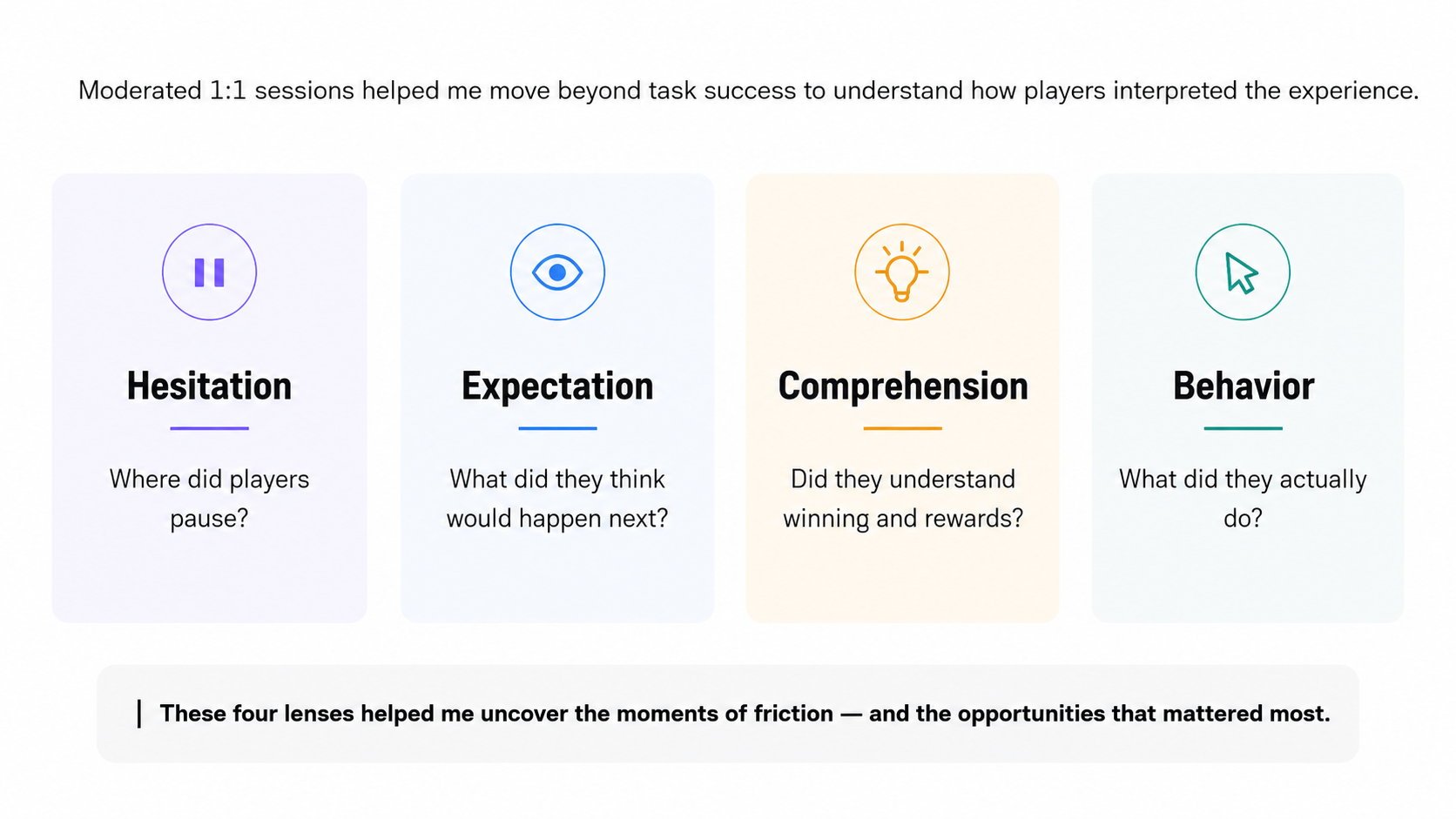
The moderated format let me move beyond whether a task succeeded or failed and examine where players hesitated, what they expected to happen next, whether they understood winning and rewards, and what they actually did.
From Individual Friction to a Pattern
In moderated sessions, a few issues kept surfacing.
Players liked the idea of a free daily reward, but some hesitated when they had to explain how winning worked, what outcome they should expect, and whether the reward was meaningful enough to make them return.
Those moments gave me something more useful than a generic usability issue: specific hypotheses to validate.
I wanted to know whether the same friction appeared when more players encountered the prototype without me there to probe, clarify, or redirect them.
That is where Maze came in.
What Players Told Us
FINDING 01: “How do I actually win?”
Players were interested in the idea of a free daily reward, but moderated sessions exposed a more fundamental problem: some players could not form a clear mental model of how winning worked.
They could move through the experience, but when I asked them to explain what determined the outcome, their answers became uncertain.
That distinction mattered.
A player can technically complete an interaction while still not understanding the system behind it. And in a reward-based experience, that uncertainty can undermine confidence in whether the outcome feels fair, predictable, or worth returning for.
The issue wasn’t simply missing instructions. The experience wasn’t communicating its reward logic clearly enough for players to build confidence in it.
What changed:
We made the winning conditions and reward communication more explicit so players could understand not just what happened, but why they received that outcome.
FINDING 02 : The Reward Had to Feel Worth Coming Back For
Players understood that a free daily game would not necessarily offer a large payout. But they were still making a judgment every time they played: was the experience rewarding enough to be worth coming back tomorrow?
In interviews, players had stronger expectations around payout than the initial concept anticipated. At the same time, the post-play experience felt too generic. The moment that should have delivered the payoff did not feel closely connected to their specific result.
That revealed a deeper issue than reward amount alone.
Perceived value came from both what players won and how the experience made that outcome feel.
A generic ending could make even a real reward feel interchangeable. Players wanted clearer acknowledgement of what had happened to them and a stronger sense that the outcome was theirs.
What changed:
We refined the reward communication and post-play experience so the result felt more personal, more clearly tied to the player’s outcome, and more meaningful as a reason to return.
What Research Changed
The research surfaced two different problems: players needed to understand how winning worked, and the reward moment needed to feel meaningful enough to bring them back.
Those findings translated directly into changes to the experience before launch.
Designing the Game Was Only Half the Problem
Once the experience itself was working, another risk became clear: players still had to find it.
FanDuel Casino already contained hundreds of games. Even a well-designed Reward Machine could fail as a daily engagement mechanic if it disappeared into an already crowded experience.
I partnered with Design and Marketing on a separate games-discovery study to understand how players scanned and navigated the Casino experience, what drew their attention, and where Reward Machine could surface naturally.
That expanded the research question from:
“Does the experience work?”
to:
“Can players find it, understand it, and build it into their routine?”
Discoverability became part of the product experience, not a downstream marketing problem.
Impact
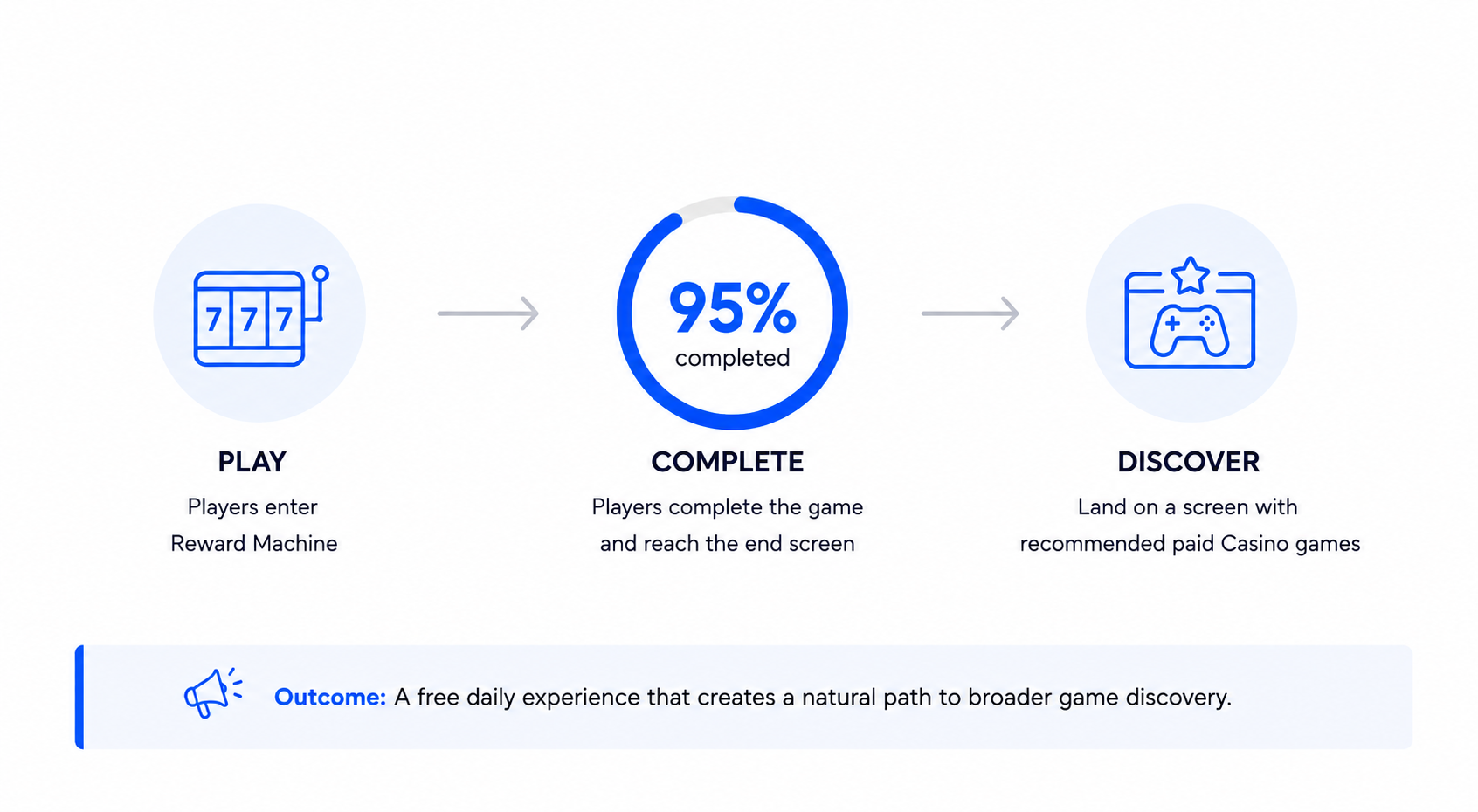
Reward Machine achieved a 95% completion rate, meaning the vast majority of players who entered the experience made it through to the end.
That mattered because completing the game landed players on a screen featuring recommended Casino games. The free-to-play experience therefore created a natural transition point from daily engagement into broader game discovery.
95%
game completion rate
Free daily play → completed experience → recommended Paid Casino games
What I’d Measure Next
A 95% completion rate showed that players were making it through the experience, but completion alone could not tell us whether Reward Machine was actually creating the daily habit we set out to build.
The next question I would want to answer is:
Did Reward Machine create incremental engagement, or simply capture behavior that would have happened anyway?
I would track:
D1, D7, and D30 return rates to see whether players continued coming back
Repeat-play frequency to understand whether Reward Machine became part of a daily routine
Engagement with recommended paid games after completing Reward Machine
Downstream paid-game play to understand whether the free experience created meaningful cross-sell
Differences between existing Casino players and Sportsbook cross-sell players
That would move the measurement from “Did players complete it?” to “Did it create lasting behavior that benefited the broader Casino experience?”
The Takeaway
Reward Machine started as a broad engagement idea. Research helped turn it into a clearer, more motivating, and more discoverable experience before launch.
The work reinforced that a daily engagement mechanic depends on more than offering something for free. Players need to understand how it works, feel that the payoff is meaningful, and be able to find the experience in the first place.
For me, the bigger lesson was that research can de-risk more than usability. It can shape the entire product loop — from concept → comprehension → motivation → discovery → measurable behavior.